Book · Feb 4–7
Reynisfjara's black sand and white surf with the Reynisdrangar sea stacks under a pale winter sky
Reynisfjara · 11:02 GMT · f/11 · 1/250 · ISO 100
Next workshop Feb 4–7 Thursday to Sunday, 2027 Meet 09:00 GMT at the church in Vík 6 photographers · 2 places left $2,900 · Book

Basalt, four-day photo workshops on Iceland’s south coast out of Vík: Basalt

Black sand, basalt and the North Atlantic. Four days on Iceland’s south coast with Hrafn Einarsson, each one set on a new moon.

  • 4days, Thursday to Sunday
  • 6photographers, never more
  • 190km of coast, from the black sand to the ice

The days

One word a day.

Each day has one subject and we stay with it. Times are for Feb 4–7, 2027, in GMT, Iceland’s time all year.

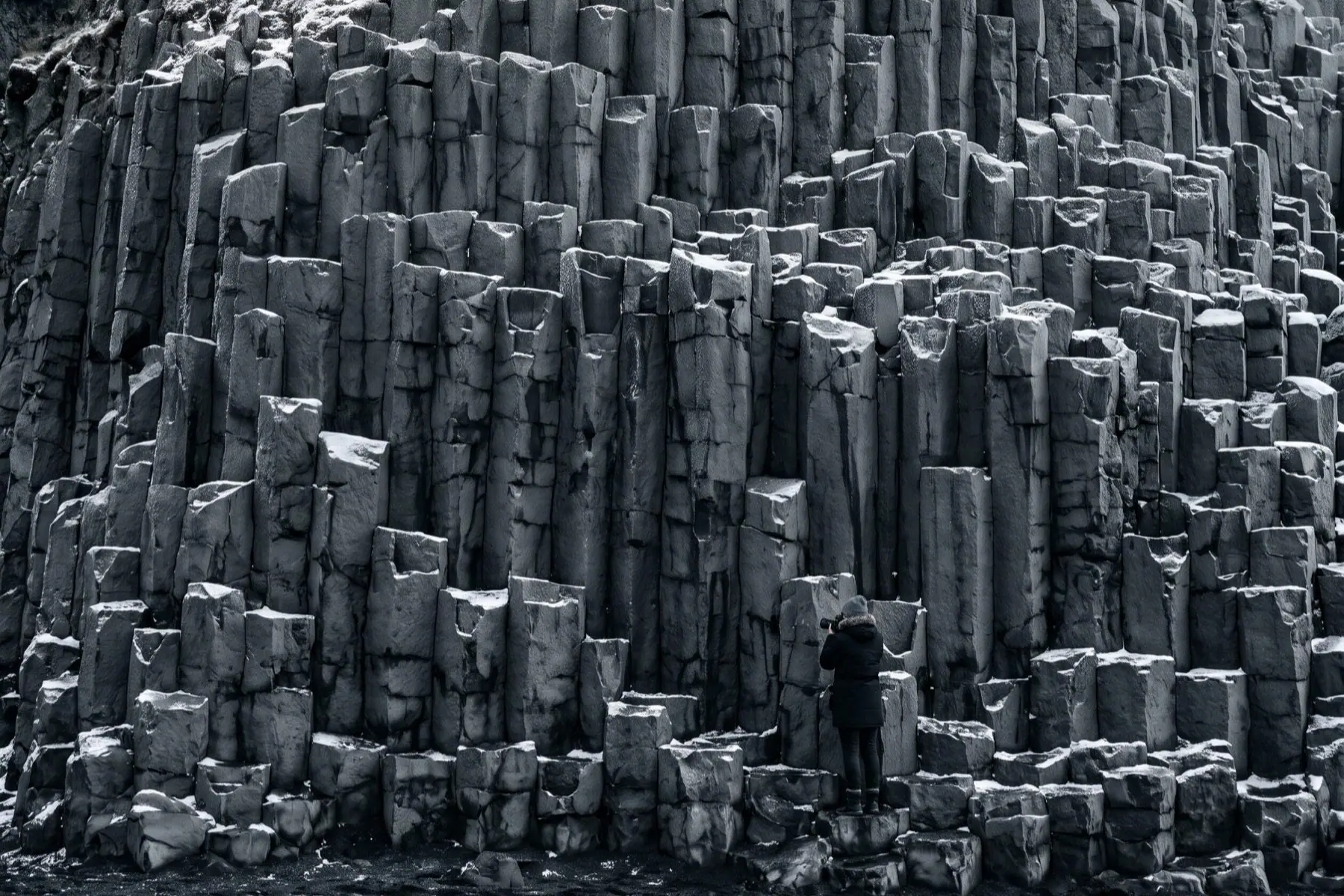
A photographer in a dark parka, small at the foot of a cliff of gray hexagonal basalt columns dusted with snow
The columns at Reynisfjara · 10:40 · f/8 · 1/125 · ISO 400

Day 1 · Thu Feb 4

Sand: Reynisfjara

The black beach under Reynisfjall: the basalt columns, the cave, the Reynisdrangar stacks out in the surf. We start with the sea talk on the sand, then spend the morning on one subject at a time.

  1. Meet at the church in Vík
  2. The sea talk, on the beach
  3. Sunrise
  4. Columns, cave, stacks
  5. Lunch, first edit
  6. Vík’s own beach, the stacks from the east
  7. Sunset

GMT · UTC+0

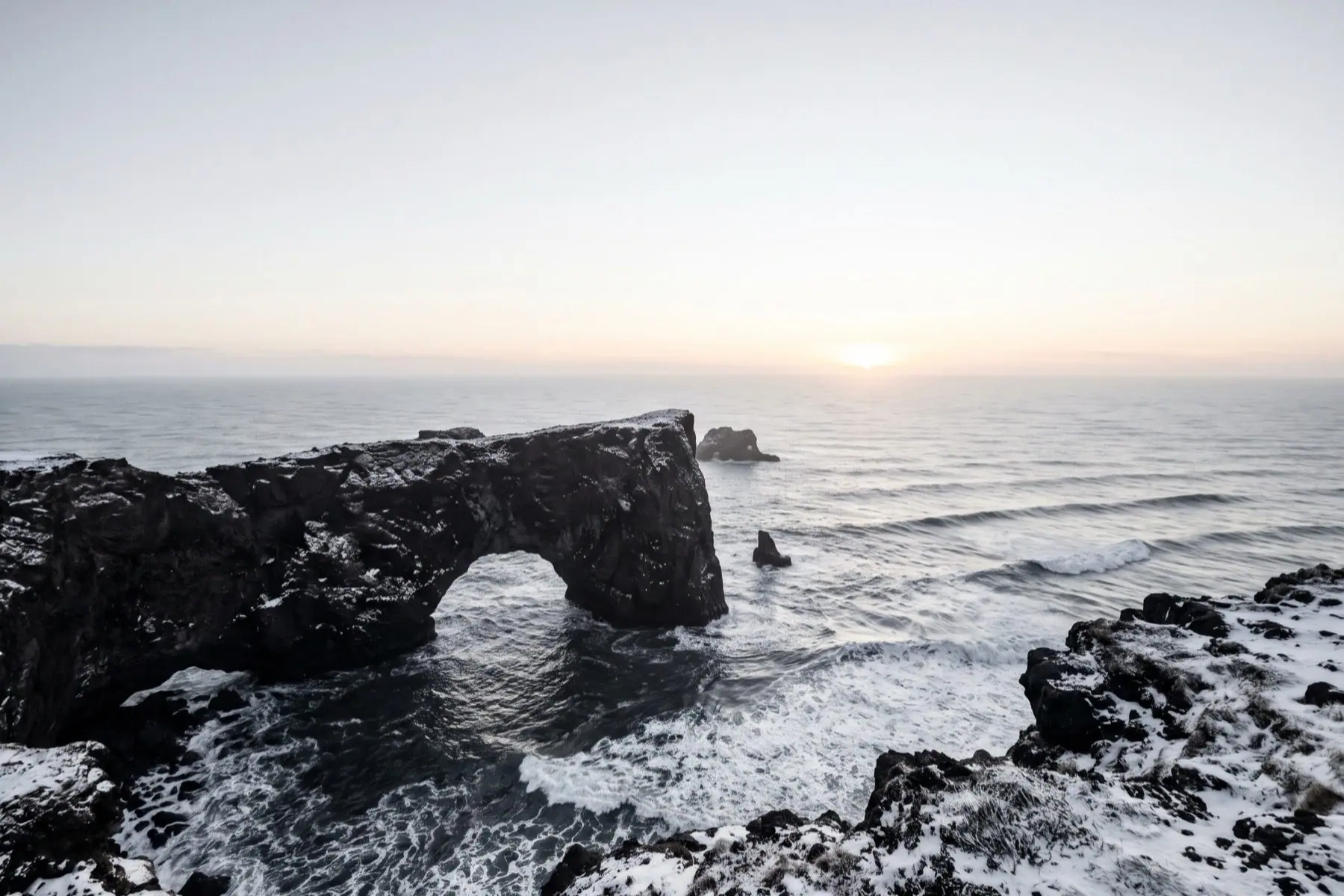
The dark rock arch of Dyrhólaey standing in a gray sea, a pale sun on the horizon and snow on the cliff in front
Dyrhólaey · 09:52 · f/11 · 1/60 · ISO 100

Day 2 · Fri Feb 5

Stone: Dyrhólaey and Sólheimasandur

Sunrise on the cliff above the arch, the whole coast laid out west to east. After lunch the long walk: four kilometers each way over flat black sand to the wreck of a 1973 navy plane, alone on the plain at last light.

  1. Leave Vík, 20 minutes west
  2. Sunrise over the arch
  3. Lunch
  4. The walk out, 4 km, about 50 minutes
  5. The wreck until the light goes
  6. Sunset, the walk back by headlamp

GMT · UTC+0

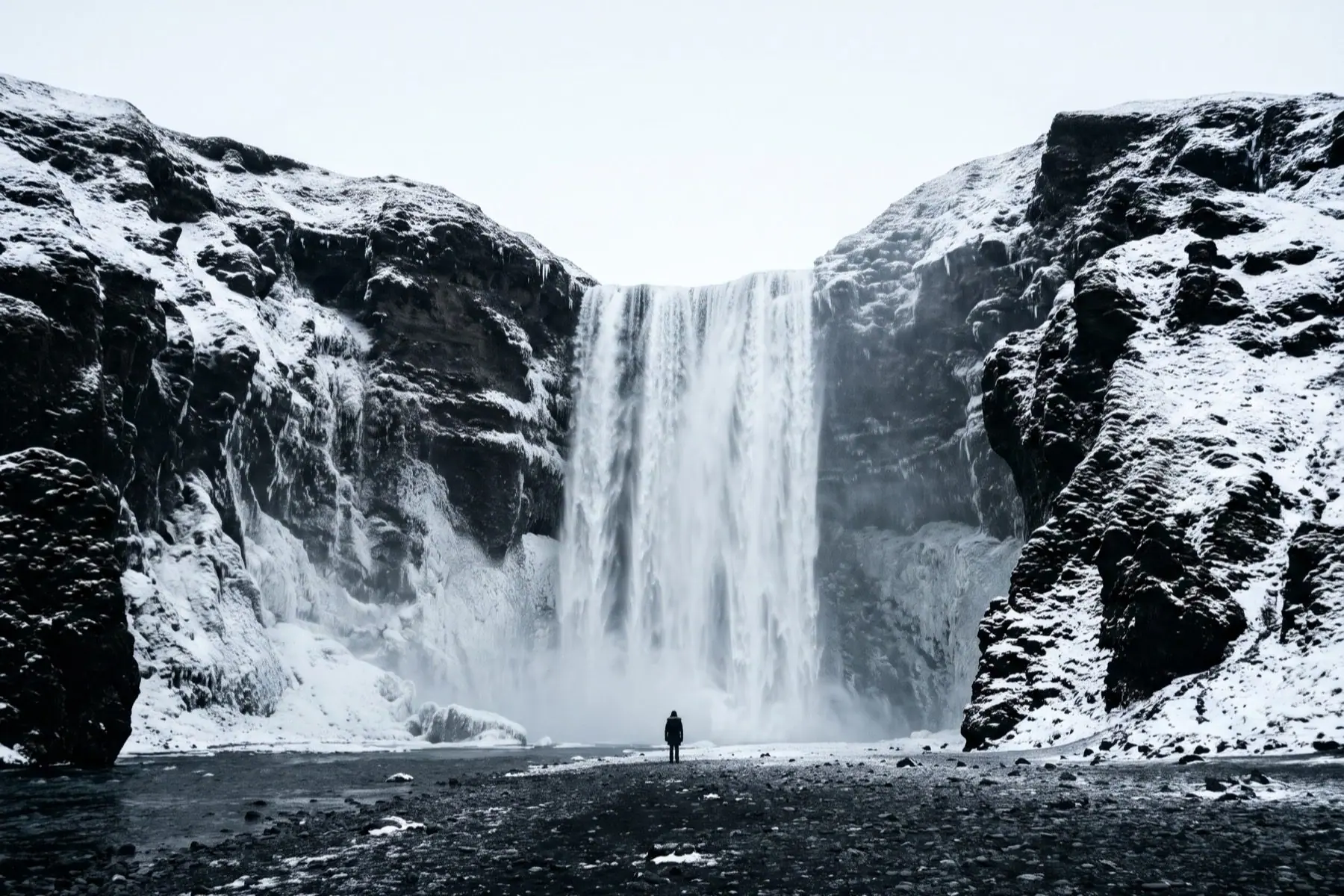
Skógafoss, a wide white waterfall between snowy black cliffs, one small figure at its foot
Skógafoss · 10:15 · f/16 · 1/4 s · ISO 50

Day 3 · Sat Feb 6

Water: Skógafoss, Kvernufoss, Seljalandsfoss

Three waterfalls in one day, all within 60 kilometers of Vík. Skógafoss is 60 meters high and 25 wide, and at sunrise in February you may have it to yourselves. The path behind Seljalandsfoss is closed when it ices, so we photograph it from the front and walk into the gorge at Gljúfrabúi instead.

  1. Leave Vík, 30 minutes west
  2. Sunrise at Skógafoss
  3. Kvernufoss, a 15-minute walk
  4. Seljalandsfoss and Gljúfrabúi
  5. Sunset
  6. Edit night, the new moon

GMT · UTC+0

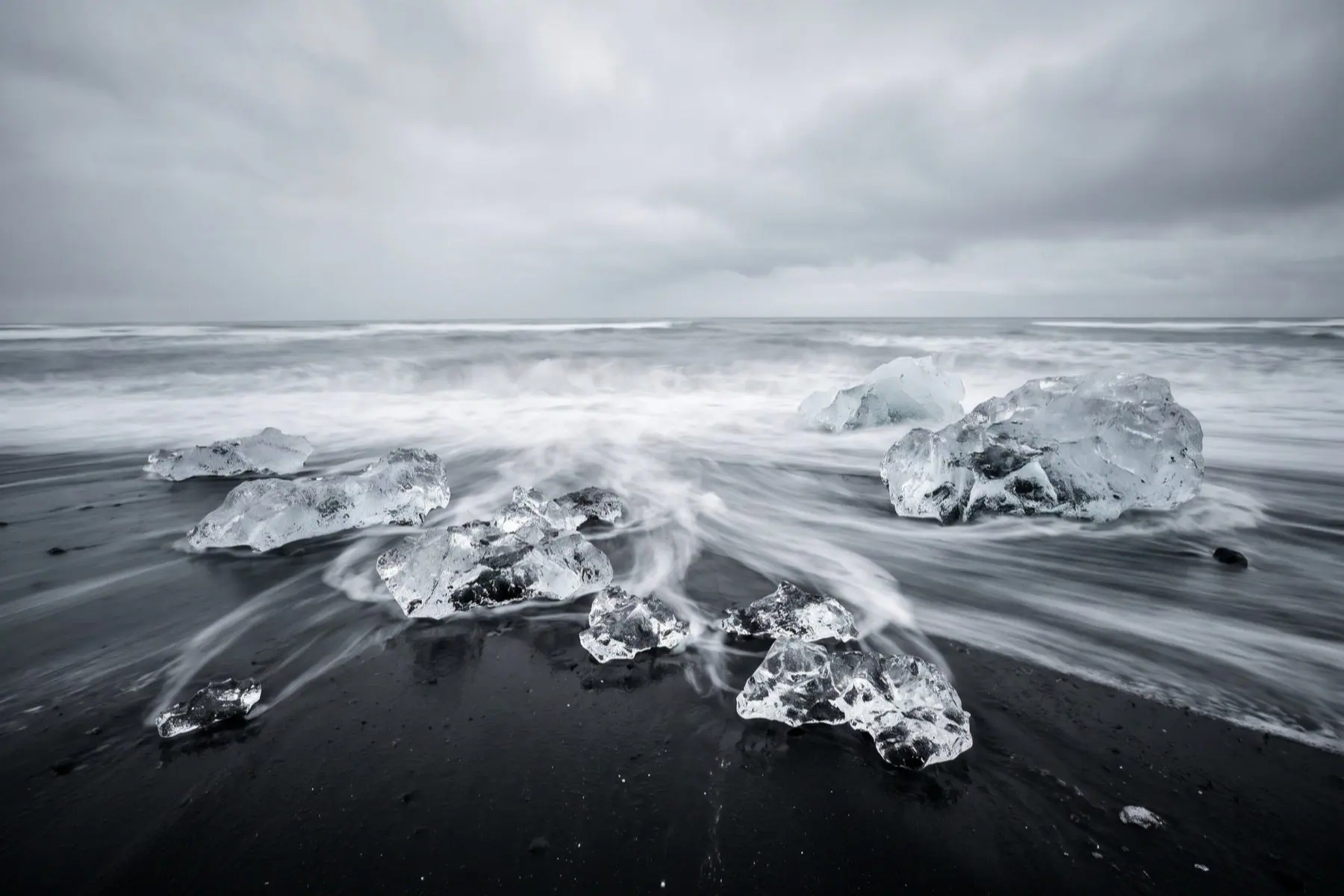
Clear chunks of glacier ice stranded on black sand, a retreating wave blurred to white mist around them
Breiðamerkursandur · 10:20 · f/16 · 1.3 s · ISO 50

Day 4 · Sun Feb 7

Ice: Jökulsárlón and the Diamond Beach

The long day. We leave in the dark for the glacier lagoon, 190 kilometers east across the lava and the outwash plains, for sunrise among the icebergs. Then the beach across the road, where the ice the sea gives back lies on black sand.

  1. Leave Vík, 2½ hours east
  2. Sunrise at the lagoon
  3. The Diamond Beach, long exposures
  4. Drive home
  5. Back in Vík
  6. Last dinner, one print each

GMT · UTC+0

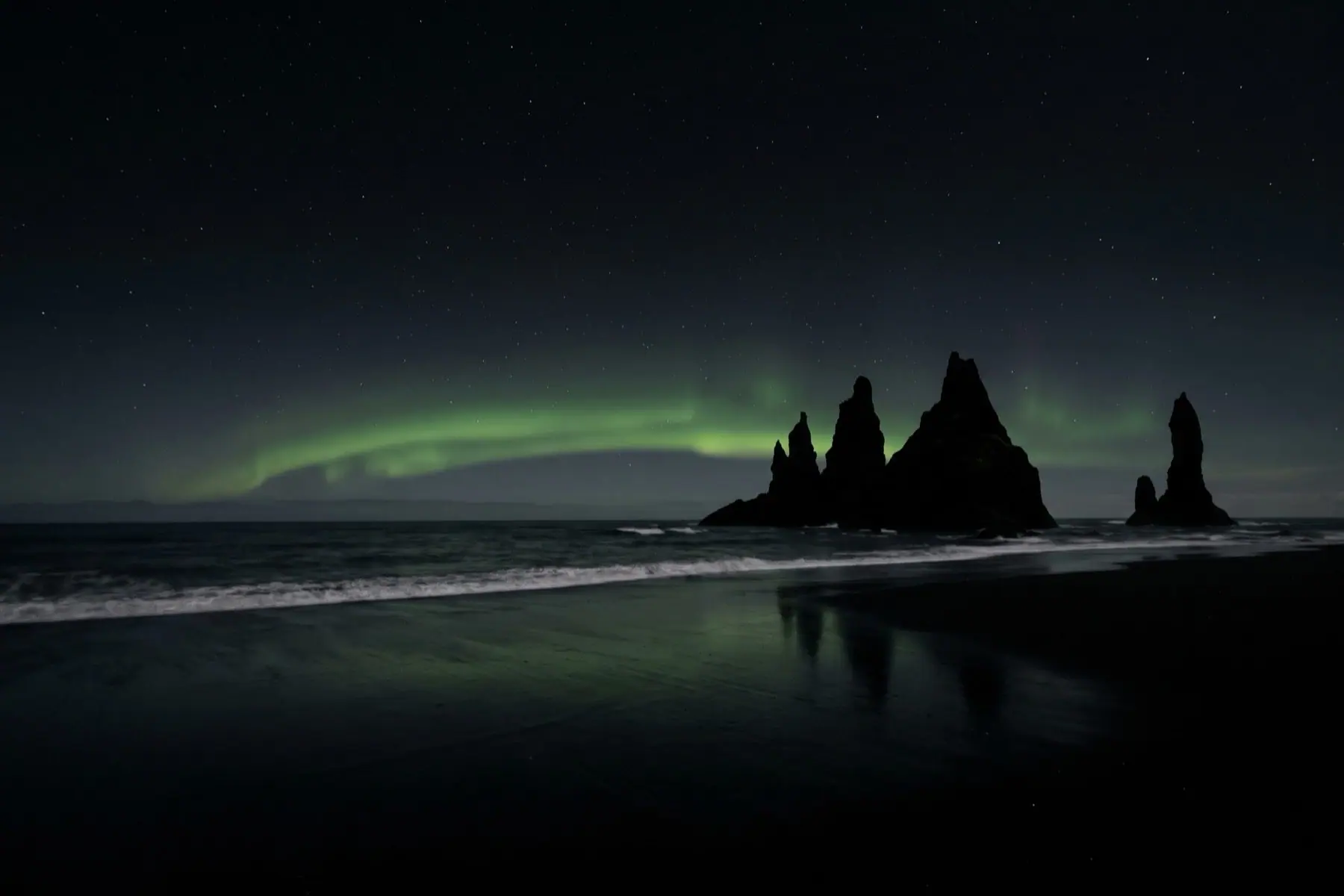
A green aurora arc low over the black silhouettes of the Reynisdrangar sea stacks on a moonless night
Reynisdrangar · 22:48 · f/2.8 · 8 s · ISO 3200

Every clear night · Feb 4–7

Night: Wherever the sky opens

Every workshop sits on a new moon, so the nights are as dark as they get. If the sky clears, I knock on your door. Aurora is never promised; a clear sky over the stacks is worth going out for either way.

  1. Dark enough to see stars
  2. Full night
  3. Aurora watch, if clear
  4. Usually back by midnight

GMT · UTC+0

Reynisfjara · the rule

Never turn your back on the sea.

Reynisfjara’s waves don’t come in a rhythm you can learn. Most run a few meters up the sand. Then one, with no warning, runs far past all the others, fast and deep, and pulls back hard into a sea of about 5°C. These are sneaker waves, and several visitors have died on this beach since 2007. I grew up here; my father was called out to this beach by the rescue team more times than I can count.

  1. 01We stand where I say: high on dry sand, well above the last wet line.
  2. 02The sea stays in front of you. No backs to the water, not for a lens change, not for a selfie.
  3. 03Nobody goes into the cave or onto the column steps when the water reaches them.
  4. 04Warning lights at the path down show the day’s conditions. When they say stay back, we photograph the beach from the cliff at Dyrhólaey.
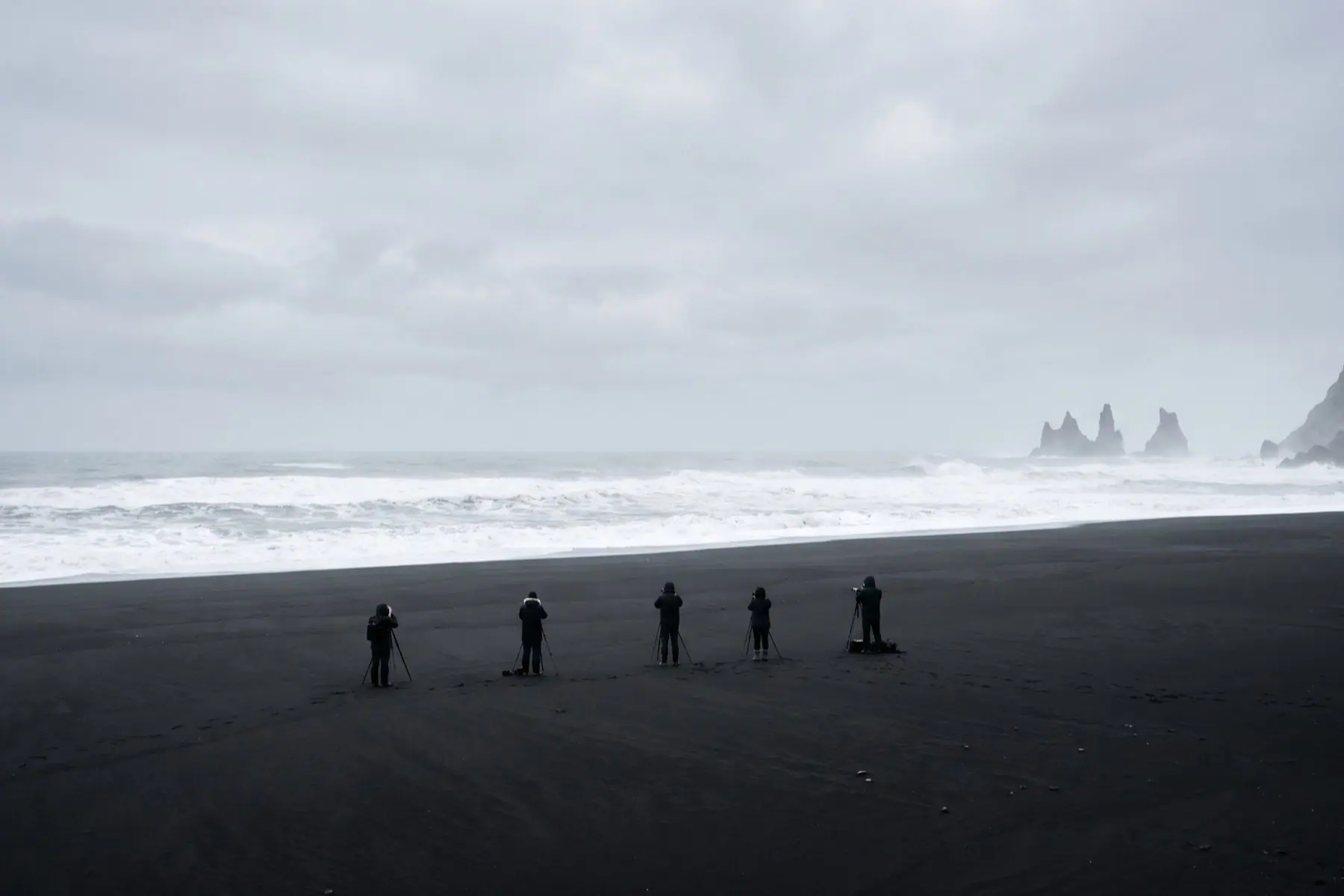
Five photographers with tripods seen from behind, standing in a line high on a black beach far back from the surf, sea stacks in the distance
The February 2026 group at Reynisfjara, well above the wet line · 10:21 · f/8 · 1/320

The light

Short days, low sun, all of it good.

In Vík it is --:-- GMT now.

  1. Feb 4–7

    7 h 34 minNew moon Feb 6

  2. Mar 4–7

    10 h 31 minNew moon Mar 8

  3. Oct 28–31

    8 h 35 minNew moon Oct 29

  4. Nov 25–28

    5 h 50 minNew moon Nov 28

Sunrise and sunset in Vík on each workshop’s first day, on a 24-hour GMT clock. In winter the sun never climbs high here, so the light at noon is the light other places get at four.

Dates · 2027

Four workshops. Twenty-four places.

  1. Feb 4–7Thu to Sun · New moon Feb 6

    2 left

    $2,900

    Book
  2. Mar 4–7Thu to Sun · New moon Mar 8

    3 left

    $2,900

    Book
  3. Oct 28–31Thu to Sun · New moon Oct 29

    6 left

    $2,900

    Book
  4. Nov 25–28Thu to Sun · New moon Nov 28

    5 left

    $2,900

    Book
  5. One dayAny day, November to March, outside workshop weeks

    Private, up to 3 photographers, 4 to 8 hours

    $480

    Book

Each workshop: five nights in Vík in your own room, breakfast and dinner, all driving, the ride from Reykjavík and back, one print. $600 holds a place.

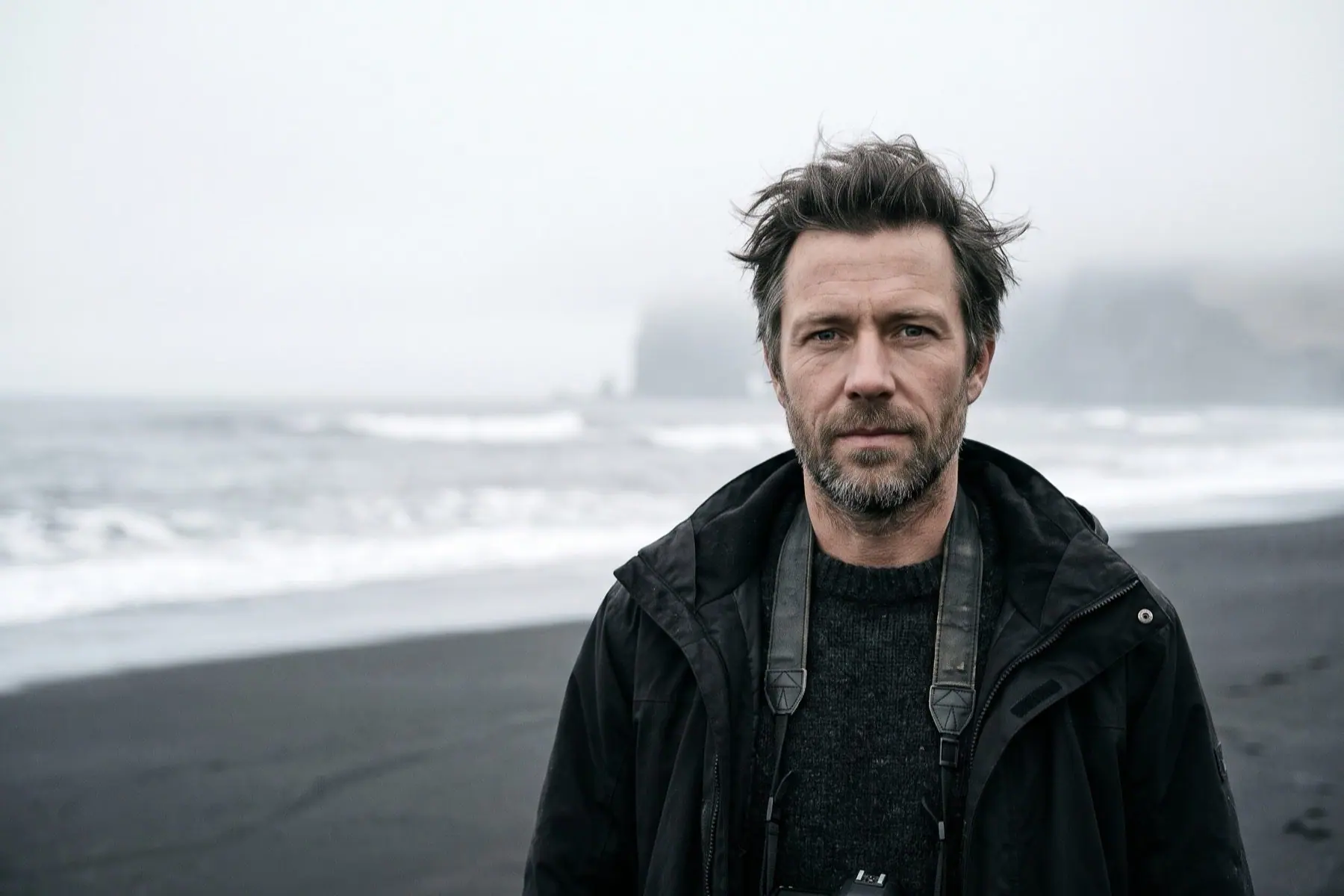
Hrafn Einarsson, a man in his forties with a graying beard and windblown hair, in a black jacket on a black beach in fog
Hrafn at Reynisfjara · 13:10 · f/2.8 · 1/500

Your guide

Hrafn Einarsson

I was born in Vík in 1980, between the black beach and the glacier. I didn’t think it was beautiful until I left.

In April 2010 Eyjafjallajökull erupted forty kilometers west of home. I came back from Reykjavík to help on my uncle’s farm and spent a week photographing the gray ash lying on the snow with my mother’s old film camera. One frame from that week, a white fence post in a gray field, is still on the kitchen wall at the guesthouse. That was the start.

I worked for years as a photographer in Reykjavík, then came home in 2016 and started Basalt with one van and six seats. I’m on Vík’s rescue team, like my father was. It makes me careful on this coast, and it means I know it in every weather.

Hrafn

Work

Black, white, and the gray between.

All from the four days, all in winter, all within 190 km of Vík. Times GMT.

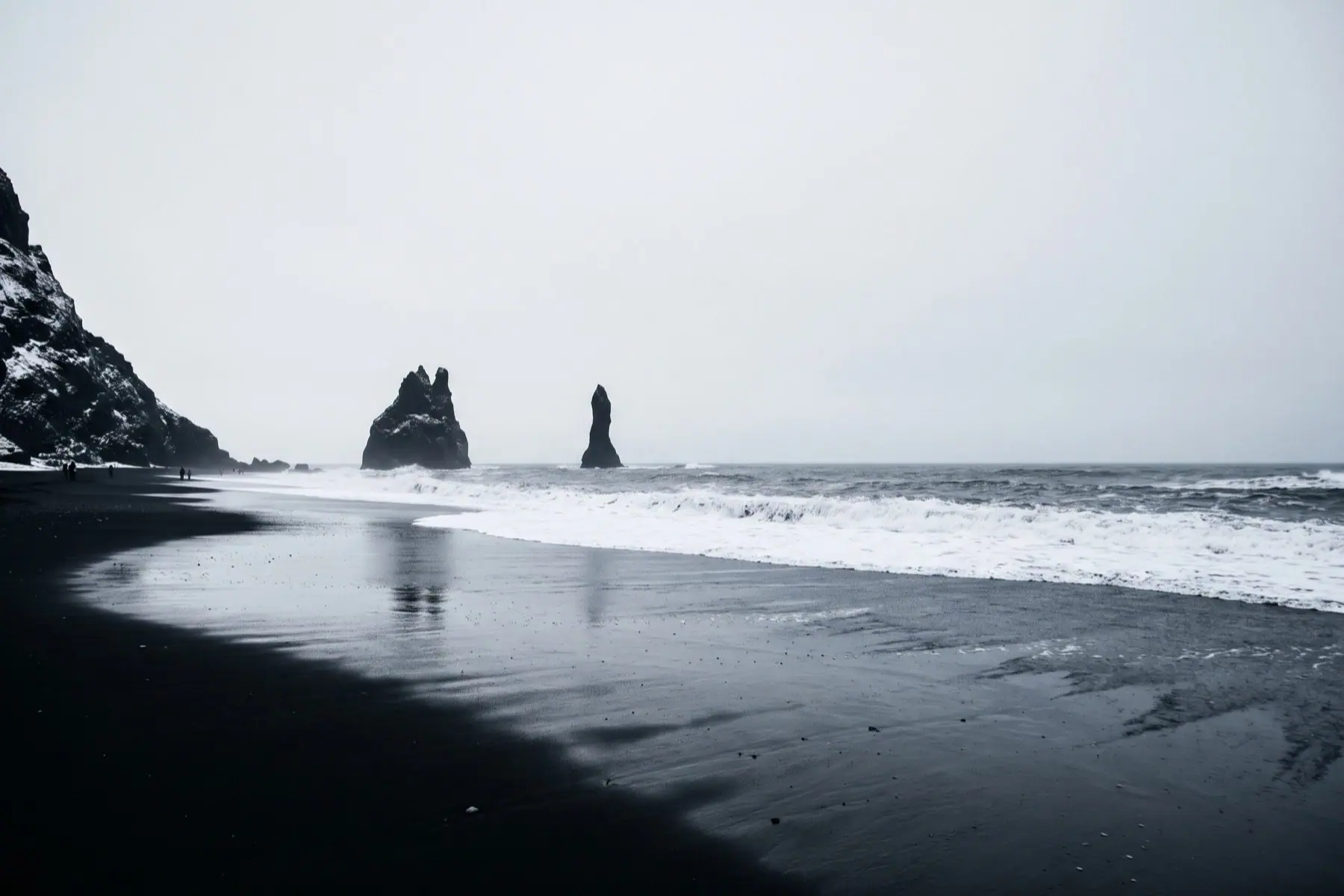
A black beach with a wet mirror of sand, white surf and two dark sea stacks under a pale sky
Reynisfjara11:02 · f/11 · 1/250 · ISO 100
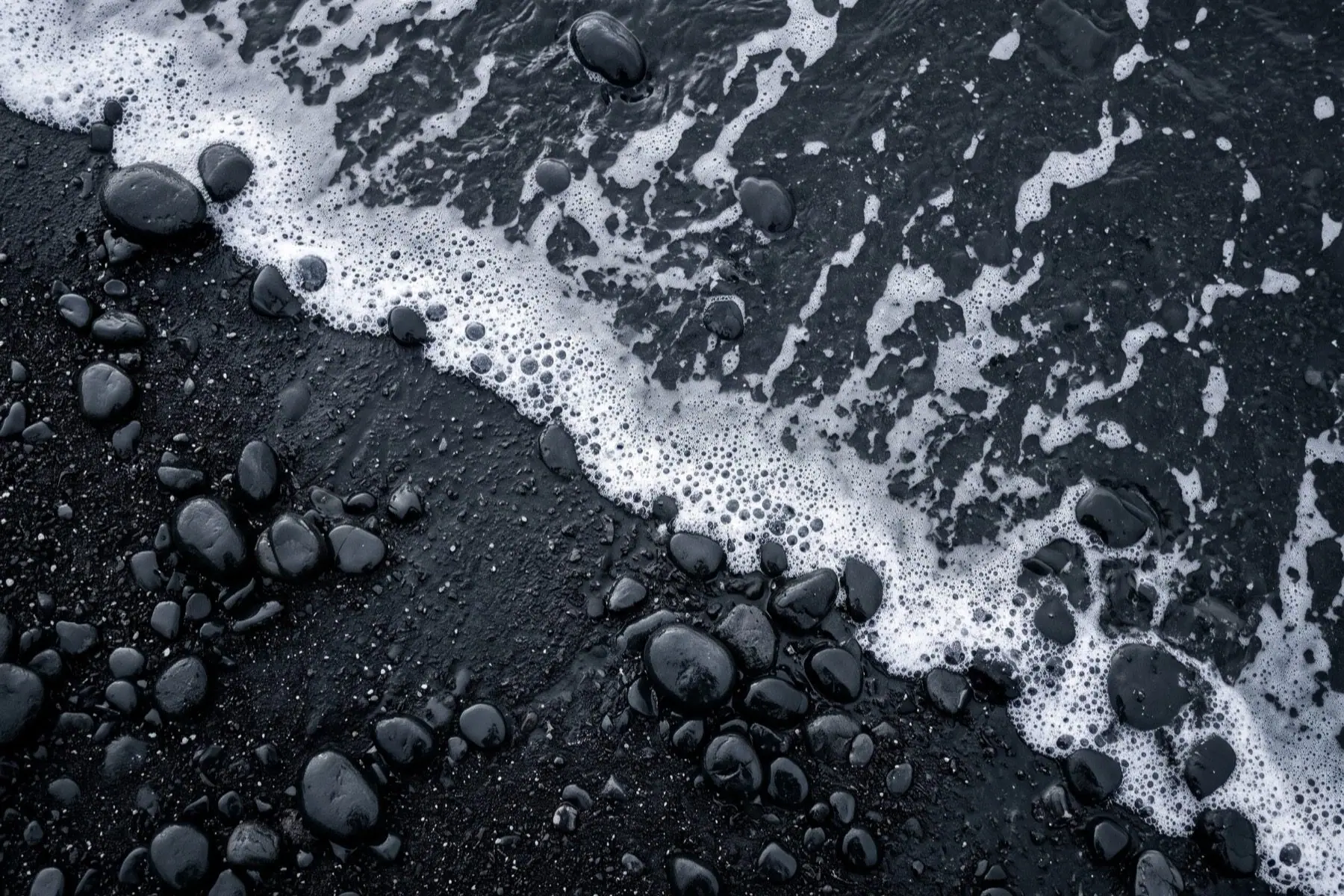
Round black basalt pebbles on wet sand with a lace of white sea foam crossing them
Foam on black stones12:30 · f/8 · 1/500 · ISO 200
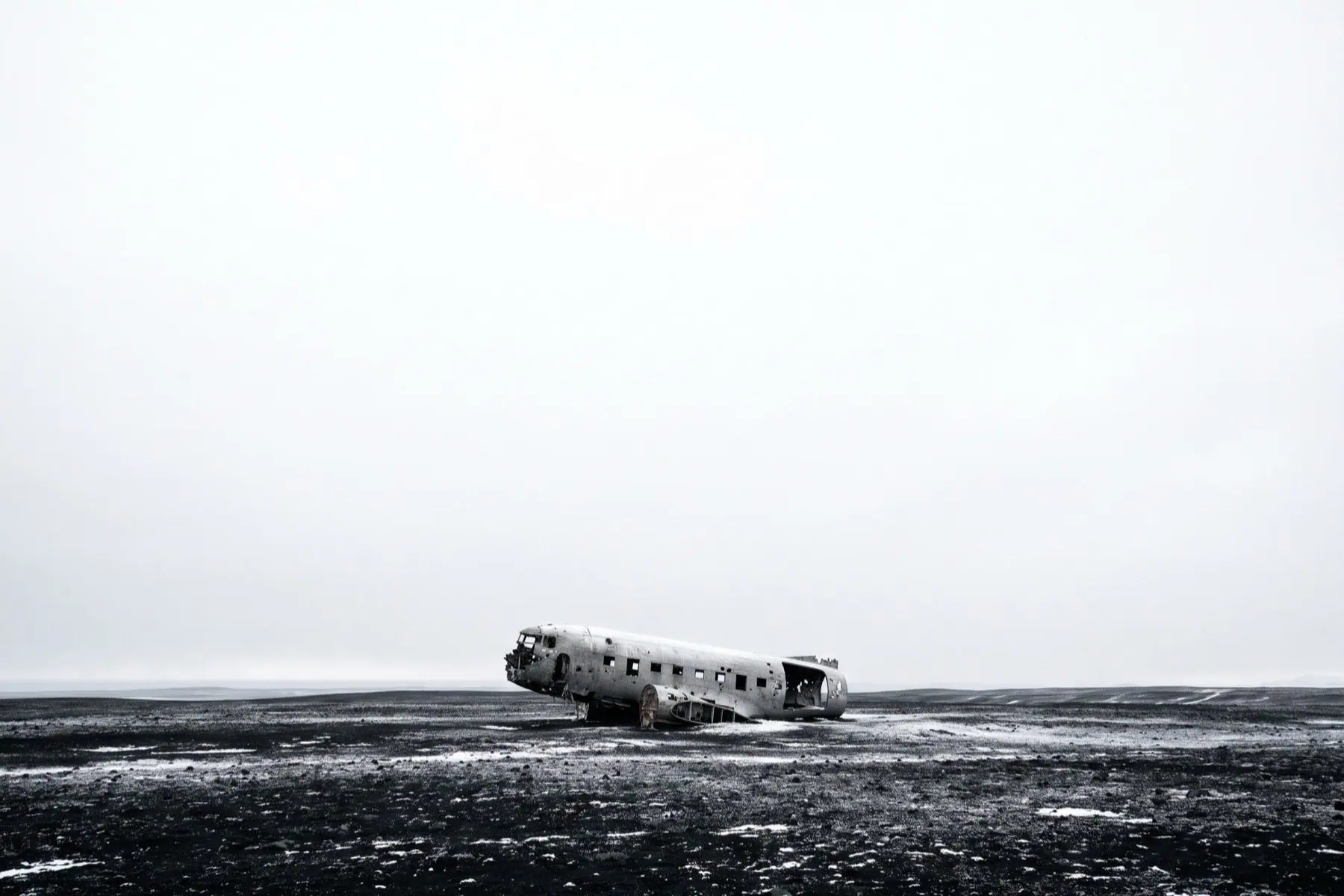
The wreck of an old silver plane alone on a vast plain of black sand under a white sky
Sólheimasandur, the wreck15:56 · f/11 · 1/200 · ISO 100
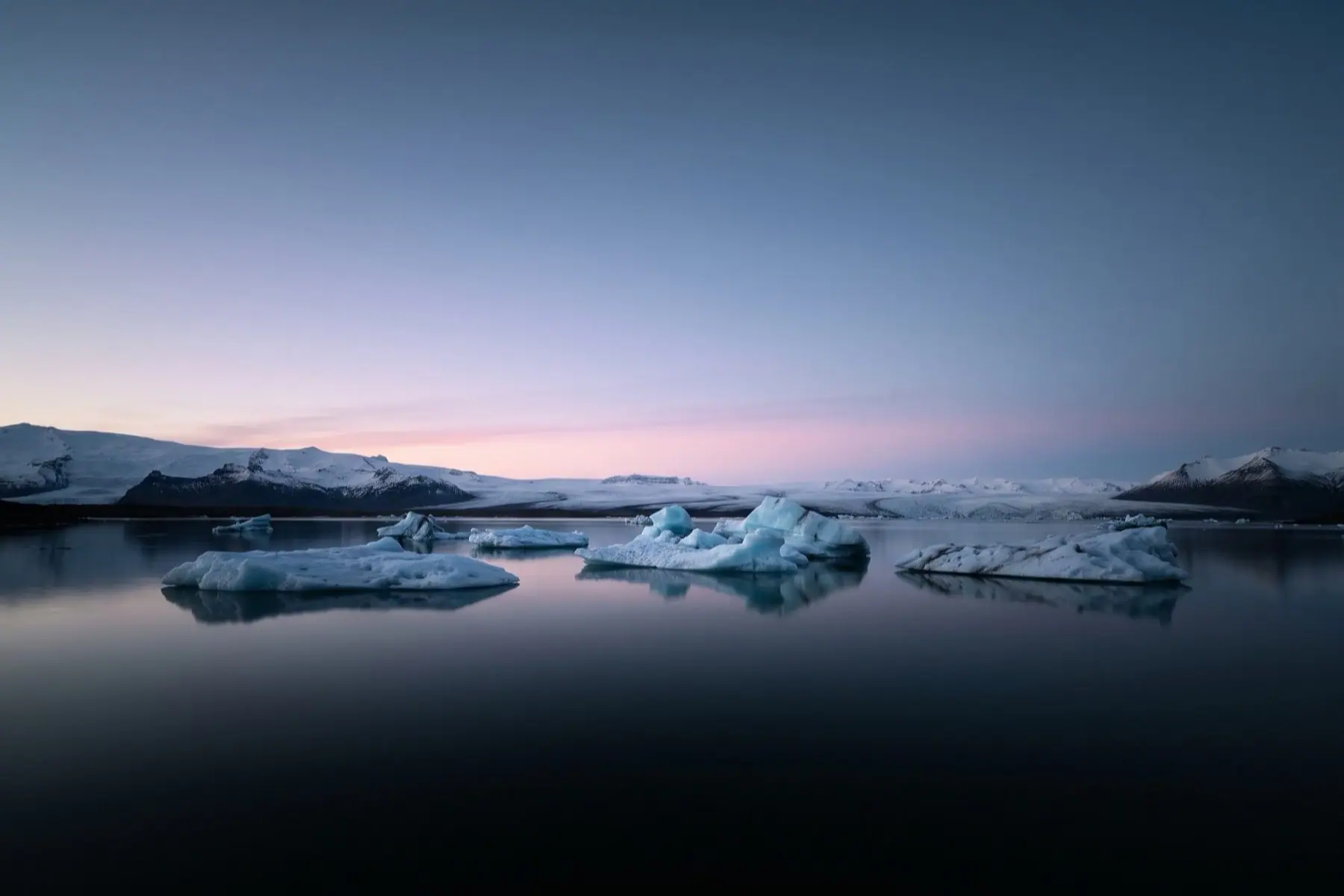
Pale blue icebergs on a still dark lagoon under a faint pink band of sky
Jökulsárlón, blue hour08:40 · f/11 · 15 s · ISO 100
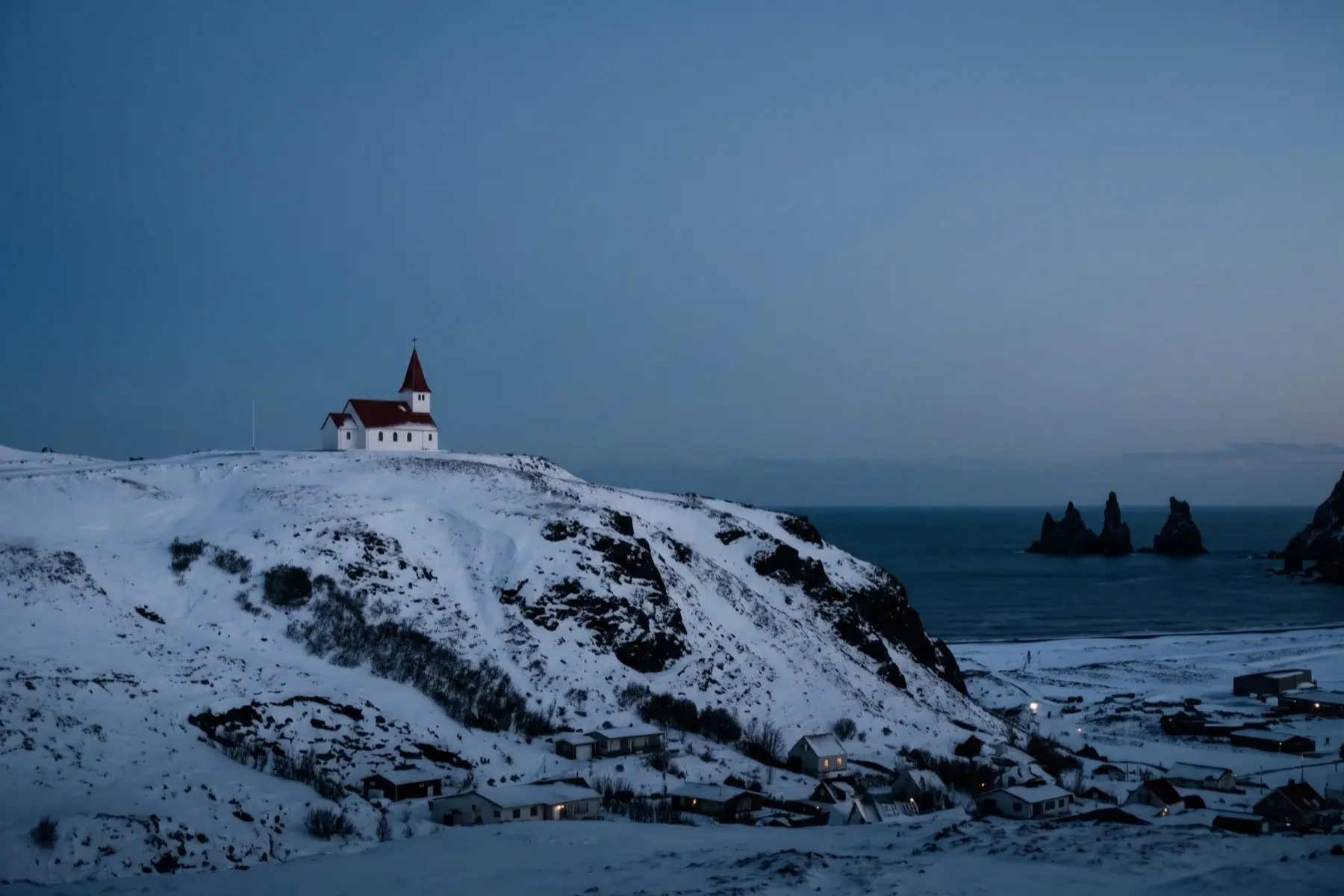
A small white church with a red roof on a snowy hill above the village of Vík at dusk, sea stacks beyond
Vík, the church17:52 · f/5.6 · 1/8 · ISO 800

Before you come

What people ask.

I only have a phone.
Then bring the phone. Half of what I teach is where to stand and when; the rest works on any camera. A small phone tripod helps at the waterfalls.
Do I need a tripod?
Yes, for the falls, the ice and the night. If you can’t fly with one, I have two to lend.
What lens?
A wide zoom does most of the work. A short telephoto for the stacks and the ice. Nothing longer than 200 mm.
What do I wear?
Wool next to the skin, a warm layer, a waterproof shell top and bottom, a hat, two pairs of gloves. Spikes for your boots are in the van.
How fit do I have to be?
The longest walk is the 8 km to the wreck and back, flat. The rest is a few hundred meters from the van. If you can walk an hour, you can come.
What if it’s gray?
It usually is, and gray is the best light on this coast: black sand, white water, nothing in between. In wind or rain we move east or west to where it’s better. Nothing is canceled for cloud.
Past groups

In their words.

  • “I’d never stood on a beach in winter. Hrafn stopped us high on the sand and told us why. Best morning of my year.”

    Mei L. Singapore · Feb 2026
  • “I came with a phone and a cheap tripod. The wreck at last light is on my wall now, printed big.”

    Daniel R. Chicago · Mar 2026
  • “Twenty years shooting weddings. Four days of shooting only what I wanted. The gray days were the best ones.”

    Ana P. Lisbon · Oct 2025

Where

Vík í Mýrdal.

Iceland’s southernmost village, 187 km east of Reykjavík on Route 1. We meet at the church on the hill above the village.

  • Ride with usWednesday 13:00 GMT from central Reykjavík, about 2½ hours in winter. Back on Monday, at Keflavík airport by 13:00.
  • Driving yourselfRoute 1 all the way. Check the road and the wind before you leave; we’ll text you the morning’s conditions.
  • TimeGMT, UTC+0, all year. No summer time.
© OpenStreetMap contributors
Vík í Mýrdal, Iceland Meet at the church on the hill, 09:00 GMT. Open the map

Questions

Before you book.

What time are these times?

Iceland’s time, GMT (UTC+0). Iceland keeps it all year, with no summer time. In February, New York is five hours behind Vík and Berlin one hour ahead.

What does $2,900 include?

Five nights in a guesthouse in Vík in a room of your own (Wednesday to Monday), breakfast and dinner every day, all driving in our seven-seat 4×4, the ride from Reykjavík and back, and one print of your best frame. Not your flights, lunches or travel insurance.

Why six?

The van has seven seats: six of you and me. Six people fit on a cliff path, around one waterfall, and in one conversation about a picture.

Will we see the northern lights?

Maybe. Every workshop is on a new moon, in the dark months, and we go out on every clear night. But it takes a clear sky and an active sun on the same night, and no one can promise both.

What if the road closes?

In a hard storm the road administration closes Route 1. Then we stay in Vík and photograph the village, the church and its own black beach, and move the day we lost if the weather lets us.

Do I drive?

No. I drive, on studded tires, and I know where the wind comes off the mountains. You keep your eyes on the coast.

How does the deposit work?

$600 holds your place. The rest is due 60 days before the workshop. Cancel before then and the deposit comes back less $100. Inside 60 days, we refund if your place is filled.

Can I bring someone who doesn’t photograph?

Yes, they take one of the six seats at the same price. Most partners end up with a camera by day two.

Book

Feb 4–7. Two places.

$600 holds your place; the rest is due 60 days before. Hrafn texts you back the same day, from Vík, in GMT.

2 left

  1. 1Service
  2. 2Date
  3. 3Details
Hold a place
Start from this design